
BCCP is a joint research center of the UC Berkeley Departments of Physics and Astronomy and the Cosmology Group at Lawrence Berkeley National Laboratory.
We also maintain close ties to the Leinweber Institute for Theoretical Physics, the Centre Pierre Binétruy, the Computational Cosmology Center, and the Berkeley Institute for Data Science (BIDS).
These are some of the projects that are either led by BCCP scientists, or that have heavy involvement from BCCP:
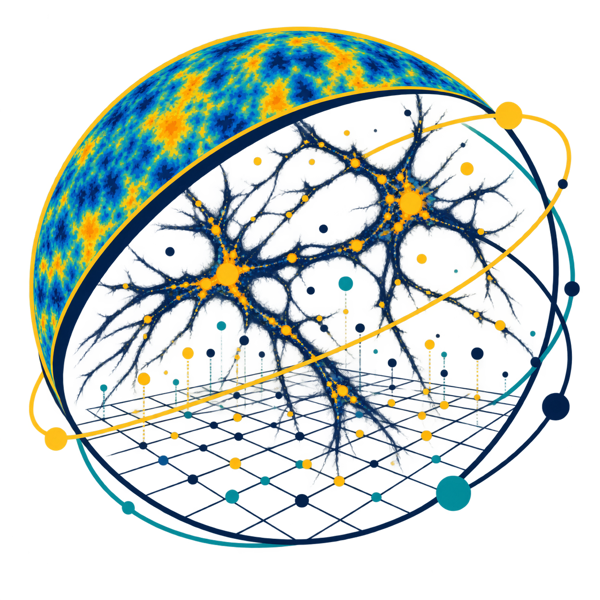
Theoretical and Computational Cosmology
BCCP researchers develop theoretical models and computational methods to study the cosmic microwave background (CMB), large-scale structure (LSS), and line-intensity mapping (LIM). This work combines analytic theory, numerical simulations, machine learning, and statistical inference to extract fundamental physics from cosmological observations. We also maintain useful software through the BCCP GitHub.
Dark Energy Spectroscopic Instrument (DESI)
DESI measures how dark energy affects the expansion of the Universe by collecting spectra of tens of millions of galaxies and quasars. Its observations create a three-dimensional map of the cosmos spanning billions of light-years.
Simons Observatory
The Simons Observatory is a set of millimeter-wave telescopes in Chile’s Atacama Desert that maps the cosmic microwave background. These observations probe the origin, evolution, and composition of the Universe, including dark matter, neutrinos, and cosmic acceleration.
Vera C. Rubin Observatory (LSST)
Rubin Observatory is carrying out the ten-year Legacy Survey of Space and Time (LSST), repeatedly imaging the southern sky. Its vast samples of galaxies and supernovae will probe dark energy and the growth of cosmic structure through weak gravitational lensing, Type Ia supernovae, galaxy clustering, and strong lensing.
Euclid
ESA’s Euclid space telescope is mapping billions of galaxies across more than one-third of the sky to trace the geometry and growth of large-scale structure over cosmic time. Measurements of weak gravitational lensing and galaxy clustering will probe dark matter, dark energy, gravity, and the expansion history of the Universe.
Nancy Grace Roman Space Telescope
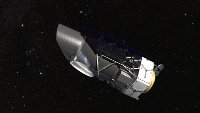
The Nancy Grace Roman Space Telescope is a NASA infrared observatory designed to investigate dark energy, exoplanets, and a broad range of astrophysics. Its wide-field instrument can survey large areas of the sky with Hubble-like resolution.

BOSS
The Baryon Oscillation Spectroscopic Survey (BOSS) was a five-year survey designed to make precise measurements of the Baryon Acoustic Oscillation signal. It obtained spectra of approximately 1.5 million galaxies and more than 160,000 quasars.

POLARBEAR
The Polarization of Background Radiation (POLARBEAR) experiment measures polarization in the cosmic microwave background (CMB). Its observations investigate the origin and evolution of the Universe and test physics beyond the Standard Model.

Dark Energy Survey
The Dark Energy Survey (DES) mapped hundreds of millions of galaxies and detected thousands of supernovae. It uses supernovae, baryon acoustic oscillations, galaxy clusters, and weak gravitational lensing to study the accelerating expansion of the Universe.

Supernova Cosmology Project
The Supernova Cosmology Project (SCP) discovered the accelerating expansion of the Universe using Type Ia supernovae. Its researchers continue to use observations from ground- and space-based telescopes to improve measurements of dark energy.

Nearby Supernova Factory
The Nearby Supernova Factory (SNfactory) develops Type Ia supernovae as tools for measuring the expansion history of the Universe and exploring the nature of dark energy.